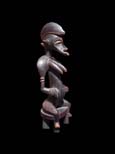
|
|
|
Ethnographic
&
Tribal Art
From the stock of Coup de Foudre, LLC
I would like a Full Page View. Before Ordering please see Terms of Sale. Please note that shipping is NOT included with the price of items in this catalogue. We will bill you for shipping and insurance later.
Je voudrais une pleine vue de page. Avant de commander voir s'il vous plaît les limites de la vente. Veuillez noter que l'expédition n'est pas incluse avec le prix des articles dans ce catalogue. Nous pour vous afficherons l'expédition et l'assurance plus tard.
Please be patient! This catalogue contains many photographs and will take a minute to download with a 55K speed modem.
Veuillez être patient! Ce catalogue contient beaucoup de photographies et prendra une minute au téléchargement avec un modem de la vitesse 55K.
Entries may not be fully catalogued and illustrated. Measurements are height x width x depth.
L'art ne peut être entièrement catalogué et illustré. Les dimensions sont hauteur x largeur x profondeur.
If you have questions about our stock or would like specific photographs of an item please contact us.
Si vous avez les questions au sujet de nos éléments ou photographies spécifiques de souhait satisfont nous envoient un email.
References and Condition statements used in this catalogue. / Références et Condition que nous avons utilisées dans ce catalogue.
New System! Internet Explorer users may find the price of an item by placing your 'mouse' over the photograph of the item.
Nouveau Système!
Vous pouvez trouver le prix d'un élément en plaçant votre 'mouse' au-dessus de la photographie (Internet Explorer seulement.)
 Buy with confidence! Your credit card transaction is secured with SSL encryption. Buy with confidence! Your credit card transaction is secured with SSL encryption.
For your convenience you may use this Currency Converter to establish exchange rates.
 Argent de converti ici Argent de converti ici
GO TO
Figures et Sculpture
Masks / Masques
Utilitarian et Ceremonial Objects
(headrests, hearth, clothing, display, etc.)
Weapons / Armes
Ethnographic Books, Prints, Photographs
(these items are now found in either the Rare Books or Prints Catalogues)
(ces éléments sont maintenant trouvés dans les catalogues des livres rares ou estampes)
OR
Use CTRL + F to search for specific material.
Utilisez CTRL + F pour rechercher les matériel spécifique.
|
|
Figures and Other Sculpture
|
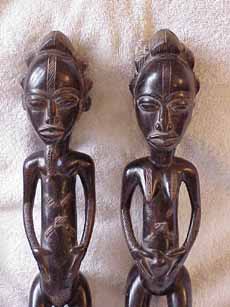
- Baule Male & Female Figures
Baule people
Côte d'Ivoire
Wood
15 inches
A very fine pair of figures from the Baule people.
Very good condition with fine smooth patina as was the French collector's preference.
|
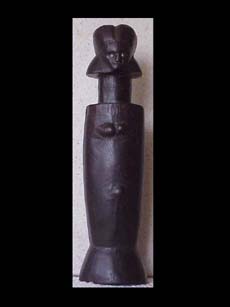
- Doll Figure
Mwana Hiti
Zaramo people
Tanzania
Wood, White Beads
19.7 cm / 7¾ inches
An old and very fine young woman's doll known as mwana hiti (wooden child). It "first appears during a young Zaramo woman's initiation seclusion. The novice treats the doll as she would her own child, and as part of the coming-out celebration, she and the doll dance together. If the woman does not bear children, she again adopts the doll as her child.... Although such figures have been referred to as fertility dolls by foreign observers, we await further field research to tell us exactly how they are used."
Flaring base, cylindrical, tubular body with one bump for the navel and two bumps for breasts, reduced size tubular neck. The whole mounted by the head which has a triangular, almost heart-shaped face, sided by encircling flared 'hair', topped by a divided coiffeur. Inset white beaded eyes.
Fine condition with old smooth patina.
CAMERON, Elisabeth L. Isn't s/he a doll? Play and ritual in African sculpture. Los Angeles: UCLA Fowler Museum of Cultural History; 1996.
FELIX, Marc L. [N. BATUWKISI, B. TURSCH, K. WEINRICH.] Mwana hiti. Life and art of the matrilineal Bantu of Tanzania. Munich: Fred Jahn; 1990.
|
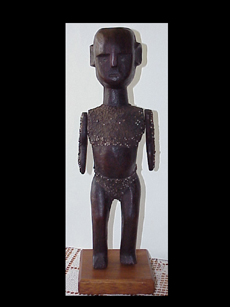
- Standing Figure
Zaramo people
Tanzania
Wood, Black Beads, White Beads
31.5 cm / 12½ inches
not including base
A very fine, old and rare doll with moving arms carved from an extremely dense, heavy wood. Shirt and cache sexe made with random, affixed beads.
In the book Mwana Hiti, Felix, et. al. write about hearing descriptions of these figures from elders, but never actually seeing one, leading them to postulate that what they were hearing described was one of the figures with moving arms that they had seen (which they depict in the book.) This figure is not what is pictured in Mwana Hiti but does seem to fit the item described by village elders who had a memory of such figures.
Fine condition with old patina. One leg slightly shorter than the other.
FELIX, Marc L. [N. BATUWKISI, B. TURSCH, K. WEINRICH.] Mwana hiti. Life and art of the matrilineal Bantu of Tanzania. Munich: Fred Jahn; 1990.
|
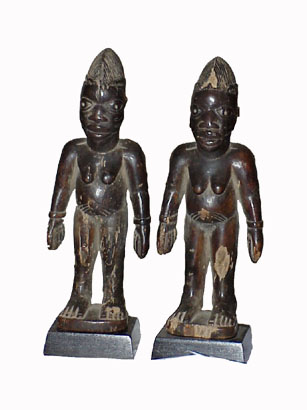
- Ido-Odo Twin Memorial Figures (ere ibeji)
Egbado (Yoruba) people
Awari District (south of Egbado)
southwest Nigeria
late 19th Century
Wood
27.5 cm. / 10 ¾ x 4 x 3 inches
not including custom-made bases
Two beautiful, sensitively and naturalistically carved female figures. Egbado tribal scarification marks, or abaja, on each cheek (three vertically stacked .) Large, holed eyes within oval-shaped lids. Large, wide nose and double, thick-lipped mouth. Verticle cleft dividing the chin. Natural-shaped ears placed well back on the head and pierced. Head adorned with high peaked coiffure sporting verticle and herringbone design knotted at the back. Incised shoulder blades, small breasts, and cross-hatched pubis. Three lines radiate out from each side of the round navel, terminating at each thigh. Free-hanging arms adorned with bracelets and well-carved hands. Long legs, large feet and toes with carved nails. The back, or posterior side, of each figure is carved with detailed shoulder blades, spine, and buttocks. Both figures stand on integral, carved bases.
This splendid old pair of ere ibeji come from the hand of a master sculptor in the central Egbado region of Yorubaland, an area known for its figures composed with fully modelled heads, muscular torsos and arms carved free of the body. The Egbado used the same facial scarification as the Oyo, with whom they maintained close ties and a common ancestry. Except in hair design, these figures also bear a close resemblance to a style characteristic of the southern Egba, who are close neighbors to the east.
If one or both twins in a Yoruba family die, their parents may request a carver to create memorial figures in the child's honor. These figures will be well cared for by the mother and may, in fact, be passed down through one or more succeeding generations -- this being determined by a diviner brought in to discover if the figures wish to be buried with the owner or passed to the next generation. The incidence of twin births among the Yoruba is high and is said to be on the order of 44 per 1000 births. In the US, by comparison, the rate is 11.
Worn but clear features with fine old patinas. Clearly defined anterior and posterior losses, on one figure, to the hair, base, anterior of one knee, and stomach.
Some, mainly posterior, losses to its twin with one ear broken where it is pierced.
Ex-Collection Dijon missionary family, collected first quarter of the 20th century.
|
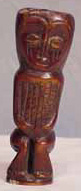
- Bone Figure
Lega People
East Central region, Democratic Republic of the Congo (Kinshasa)
Bone
CORNET, Joseph. A Survey of Zairian art. The Bronson collection. Raleigh, North Carolina: N. Carolina Museum of Art; 1978.
Fine condition a with great patina.
|
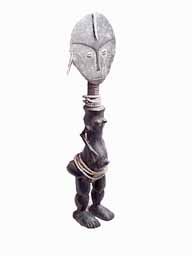
- Fertility Doll
Akua'ba (plural nkua'mma)
Ashanti people, Ghana
Wood, Glass Beads
15 inches tall
Fine condition with some encrustation.
Fertility doll in the representational style, a style which is thought to have developed around 1940. Cole and Ross (1977, page 105) estimated that these figures were less than 1% of the total number of nkua'mma (sometimes pluralized as akua'maa in the English literature. For more images click here.
|
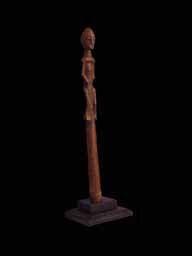
- Lobi-World Figure
Lobi peoples, Burkina Faso
Wood
16.75 inches / 43 cm. (not including the stand/base)
Very good condition with scratches at the bottom of the post. Lacking one of the hands. Mounted on wood, 2-tiered base.
|
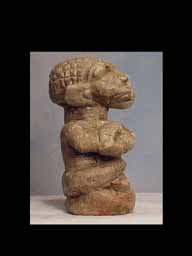
- Nomoli
Sherbro-Bullom culture, Sierra Leone
circa 16th Century
Steatite
21.3 x 11 x 12.7 cm.
Squat figure sitting on folded legs (Yogi style) with each arm outstretched, the hands holding the large pointed breasts. Hole for magical substances in the top of the head. Said to relate to agricultural fertility, particularly in the rice fields
Good condition. Lacking part of one breast, section of the nose and upper lip.
|
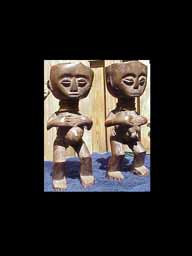
- Pair of Figures: Seto & Nabo
Ngbaka people
Ubangi River Region, Democratic Republic of the Congo (Kinshasa)
Wood
7½ inches
The brother and sister Nabo and Seto are the two mythical ancestor/founders of the Ngbaka people. Their figures are venerated and kept at family altars. Such statues are activated with libations which incure good fortune, protection and healing. The Ngbaka, who share northwest Congo with two other groups, have produced the greatest art in the region, most of which is devoted to Nabo and Seto. Their statuary is said to relate almost exclusively to ancestor and spirit cults while their masks, along with those of the Mbanja, relate to rituals of the gaza initiation society.
Very good condition with recesses in the tops of their heads, presumably for holding ritual substances.
|
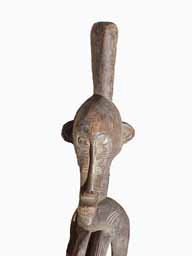
- Rhythm Pounders
Ndebele (frequently mislabeled 'deble')
Senufo people, [central region?]
Côte d'Ivoire
Poro? or Lo? society
Wood
143.6 cm.
Two ndebele (sing. ndeo, 'bush spirit') with baboon faces, one being male, the other a smaller female.
These figures served the Poro Society which trains individuals in courage, strength, truth, knowledge, obediance, enduramce and discipline of mind and body.
In much of the previous literature these figures are called 'deble.' The actual term used by the Senufo is ndeo which translates as bush spirit. The plural form of the word is ndebele -- which is often corrupted to deble.
LEYZINGER,Elsy. African sculpture. A descriptive catalog by ---. Zurich: Museum Rietberg; 1963. Pages 64-67, figure 23.
Glaze, Anita J. Life and death in a Senufo village. Bloomington: Indiana Univ Press; 1981, pp. 196-97.
Good to very good condition with well-done repairs to necks and arms.
|
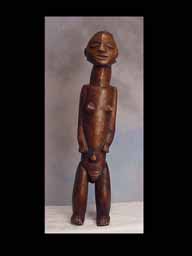
- Standing Figure
Luba Shankadi
Southeastern Democratic Republic of the Congo (Kinshasa)
Circa 1940s or before
Hard wood
58.5 x 12 x 11 cm./ 23 x 4¾ x4 5/16 inches
Fine condition with a rich warm patina and having the typical terraced coiffure at the back of the head. Holes thru each foot from old mounting. Very old labels under both feet.
SEE: Figure 195, in African sculpture. A descriptive catalog by Elsy Leuzinger. Museum Rietberg Zurich. 1963.
SEE: Collecting African art 1890s - 1950s. Item 46, Hurst Gallery, Cambridge, MA., March 1996.
|
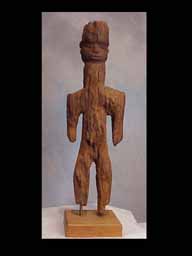
- Statue of a Man(?)
Lobi people, Burkina Faso
bateba duntundara
Wood
40 x 12 x 5 cm. (not including the stand/base)
Typical Lobi figure with arms hanging straight down at its sides.
Poor condition. All of body, except face, eroded and termite consumed, still, an elegant sculpture. Mounted on wood base.
|
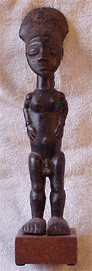
- Male Figure
Kulango people
Côte d'Ivoire
Wood
14¼ inches plus base
A very fine and uncommon figure from the Kulango people.
Very good condition with fine patina. Some loss at rear of feet.
|

- Ape Figure
Mambila
Cameroon
Wood
cm. / 14¾ inches
Ape with beautiful stylized face and figure standing with one hand to his chest, the other trailing on the ground. This is a contemporary item (i.e. not old) purchased solely for its artistic, rather than ethnographic, merit.
Fine condition.
|

- Boli Fetish
Bambara people
Mali
Clay Exterior,
cm. / inches
|

- Nomoli
Sherbro-Bullom culture, Sierra Leone
circa 16th Century
Steatite
x x cm. / 5 inches
Squat figure sitting on haunches with arms crossed in front, elbows resting on knees. Hole for magical substances in the top of the head. Said to relate to agricultural fertility, particularly in the rice fields
Very good condition. Gray in color with patina.
|
Masks
|
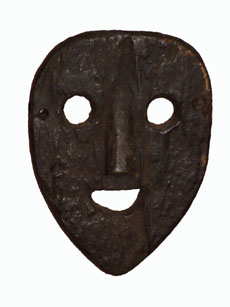
- Mask
Thakali people
Karnali Region
Western Nepal
Wood, Cotton Twine
26.3 x 18.5 cm. / 10¼ x 7¼ inches
A beautiful example of a Himalayan mask in the shamanic style with origins in a pre-Hindu, pre-Buddhist animist tradition.
For an excellent discussion of Himalayan masking traditions see the article Demons & Deities. Masks of the Himalayas by Thomas Murray, © 1995, HALI Annual #2, Asian Arts.
Very good condition with small abrasions on the upper right edge of mask. Heavily encrusted with fine patina. Click here for a larger image.
|
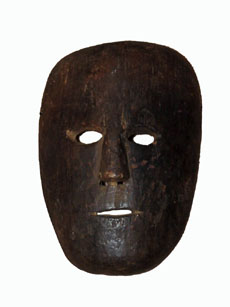
- Mask
Thakali people
Karnali Region
Western Nepal
Wood
26.2 x 18.5 cm. / 10¼ x 7¼ inches
A beautiful example of a Himalayan mask in the shamanic style with origins in a pre-Hindu, pre-Buddhist animist tradition. Larger image here.
For an excellent discussion of Himalayan masking traditions see the article Demons & Deities. Masks of the Himalayas by Thomas Murray, © 1995, HALI Annual #2, Asian Arts.
Very good condition with fine patina.
|
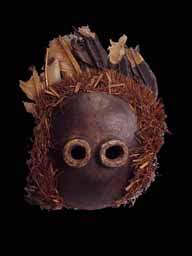
- Gitenga Mask
Gitenga version of a Minganji mask
Western(?) Pende people
Bandundu, left-bank Kwilu?, Democratic Republic of the Congo (Kinshasa)
Mukanda (Initiation)
Collected 1986
Wood, Raffia, Feathers, Leather
25.5 x 21 x 7 cm.
Metal & Plexiglass Rod Support With Smoke & Clear Plexy Base
Red-brown convex wooden discoid mask with two tube-like projections serving as eyes. Surrounding the back of the mask, to conceal the head of the wearer, is a lattice of looped raffia into which the feathers are tied. The ends of the projecting tube eyes are covered with light-coloured, soft leather. Click here for a view of several dancers in minganji masks from Herreman (see citation below.)
This is a fairly rare example of a type of minganji mask called gitenga. Minganji costumes are found throughout the Pende areas of southwest D.R. Congo. Each of the various types of minganji costume could be determined by its accompaniments and the dance of the individual who wore it; thus they were identifiable only in situ in an active rite. Outside of that context one can only guess at which element of the Pende pantheon is being represented. The apparent exception to this rule, however, occurs with these rare discoid wooden masks which are said to represent death. A few extant examples of the wood gitenga mask are known to possess heart-shaped faces (photo copyright by A. Cauvin).
For an example of the raffia version of the minganji mask see the next item in this catalogue.
HERREMAN, Frank & PETRIDIS, Constantijn, editors. Face of the spirits. Masks from the Zaire basin. Antwerp; 1993.
Fine condition, retaining old raffia and bird feathers.
|
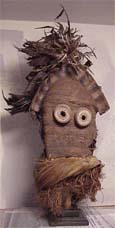
- Mask
? version of a Minganji mask
Pende people
Democratic Republic of the Congo (Kinshasa)
Mukanda (Initiation)
Raffia, Feathers, Kaolin
cm.
Click here for a view of several dancers in minganji masks from Herreman (see citation below.)
Minganji costumes are found throughout the Pende areas of southwest D.R. Congo. Each of the various types of minganji costume could be determined by its accompaniments and the dance of the individual who wore it; thus they were identifiable only in situ in an active rite. Outside of that context one can only guess at which element of the Pende pantheon is being represented.
For an example of the rare discoid wood version of the minganji mask see the previous item in this catalogue.
HERREMAN, Frank & PETRIDIS, Constantijn, editors. Face of the spirits. Masks from the Zaire basin. Antwerp; 1993.
Very good condition.
|
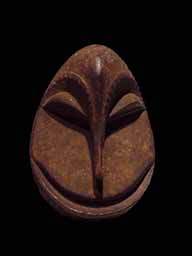
- Mask
mwisi gwa so'o
Hemba people, Democratic Republic of the Congo (Kinshasa)
Collected 1978
Wood
21.5 x 15 x 9.5 cm.
An astonishing, stylized caricature of the Zairean chimpanzee, locally called So'o. The sculpture as a whole is rather egg-shaped with the cresent mouth extending along the bottom rim of the face and partway up the sides. Hash marks over the down-pointing cresent eyes, resembling wrinkled brows, provide a look of grimace or wildness. The nose is a tapering pointed affair carved in total relief from the face and descends from a bulbous forehead. The obverse of the mask is vacated along the bottom behind the mouth, providing a comfortable handhold (which is highly patinated). One hole along the perimeter at either side for attachment of support thong. One of the finest we've seen and one of the first to make it's way to the west.
Apparently, these masks were held in the hand or worn on a belt and were used during the time of a funeral in the village. The first day it represented the chimp as a force of disruption and chaos and was used to frighten pregnant women and children. The second day it represented the chimp as an agent of wisdom and superior understanding. This mask type was 'unknown' to westerners until the mid-to-late 1970s when a few began to surface from traders in eastern Congo and Tanzania.
HERREMAN, Frank & PETRIDIS, Constantijn, editors. Face of the spirits. Masks of the Zaire basin. Catalog of the Exhibition. Antwerp, 1993.
BLAKELY, T. D. & P.R. So'o masks and Hemba funerary festival. IN: Africa Arts, 21 (1): pp. 30-37, 84-86; 1987.
Fine condition. Nose and obverse of the chin area highly patinated and shiny from handling. Encrustation over the rest of the front surface. Wired to hang on wall.
|
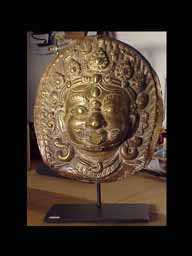
- Bhairava Mask
Hindu (Buddhist Iconography)
Nepal
Bronze
Steel armature stand painted black.
Used once a year during the multi-day Indra Jatra festival, this mask represents Bhairav, the angry manifestation of Shiva. The mask would be placed in front of a pot filled with chang (home brewed beer) which is funneled through a pipe emerging from the hole in Bhairava's mouth. Both Hindus and Buddhists hold Bhairava holy.
PAL, Pratapaditya. Icons of piety, images of whimsy. Asian terra-cottas from the Walter-Grounds collection. Los Angeles County Museum of Art, 1987.
Fine condition.
|

- Kakuungu Mask
Southern Yaka/Suku, Democratic Republic of the Congo (Kinshasa)
Nkanda (Initiation)
Pre-1950s (1940s was given date when purchased)
Wood,Palm Leaf, Beads, Organic Matter, White Pigment
91.2 x 26 x 28 cm.
35.9 x 10.24 x 11 inches
Metal Stand W/ Metal Base
Large, massively featured mask with palm leaf strip fringe (called futi or kindua). Raised ridge running length of crown of head. Large hooded eyes, puffed cheeks and chin. Incised line creating ridge of nose. Mouth open with teeth exposed. A few red beads imbedded into organic remains on surface. Traces of white on eyes, teeth, ears and chin. Small vertical handle at the front center of the base. Perimeter holes for the suspension of a concealing fiber robe.
BOURGEOIS, Arthur P. Kakungu among the Yaka and Suku IN: Africa Arts, vol. 14, no.1, pp. 42-46, 1980.
BOURGEOIS. Art of the Yaka and Suku, Meudon: Alain et Francoise Chaffin.
BOURGEOIS. The J. Hautelet kakuungu mask. 11 November 1989. Research paper prepared for Mr. J. Hautelet.
Private communication from Dr. A.P. Bourgeois to W. L. Norman, 15 July 1994.
Very good condition.
|
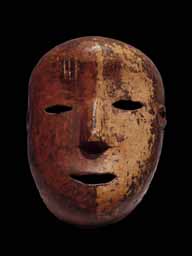
- Ngbaka (Or Mbanja) Mask
Equatorial Province, Ubangi, Democratic Republic of the Congo (Kinshasa)
Gaza (Initiation-circumcision)
Said to pre-date the 1950s
Wood, Kaolin & Ochre Pigment
23 x 16.7 x 9.5 cm.
Mask with right side painted with white kaolin, left side ochre. Oval slit eyes, half-oval slit mouth. Small, cone-shaped projecting nose. Three verticle incisions above each eye. Small C-shaped ears with a hole in the center of each. Hole above and behind each ear for an attaching strap. [The straightforward simplicity of this mask is reminiscent of some of the Japanese Noh masks.] Said to be used in rituals related to the gaza initiation society (an initiation followed also by the Mbanja.
BURSSENS, Herman. Mask styles and mask use in the north of Zaire. IN: Face of the spirits. Masks from the Zaire basin. Catalog of the Exhibition, Antwerp, 1993.
Very good condition with much evidence of wear and possessing a warm patina. Wired to hang on wall.
|
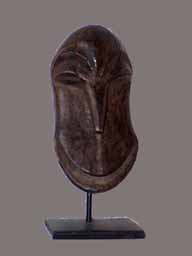
- So'o Passport Mask
Hemba people
Democratic Republic of the Congo (Kinshasa)
Wood
cm. / 5 5/8 inches
(not including custom-made stand)
A passport-size So'o chimpanzee mask.
Fine condition.
|

- Mende Bundu Society Mask
sowo-wui
Mende people
Women's Bundu Society
Sierra Leone
Wood
cm. / inches
Very good condition.
|
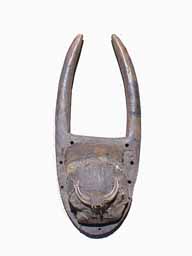
- Mask
Toma people, Liberia
Wood, Leather, Tusks, Nails
67 x 28.5 x 14.5
A thich, flat, U-shaped panel pierced through with attachment holes near its exterior circumference with two inward curving 'horns' projecting from the flat top of the 'U'. The centre of the mask is covered by a bulbous leather pouch projecting from the surface to which is attached two (warthog?) tusks.
Very good condition.
|
Utilitarian & Ritual Objects
|
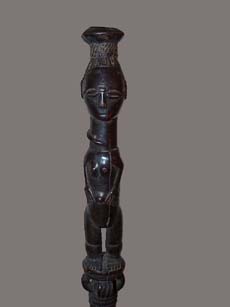
- Prestige Staff
Akye (Attie) or Ebrie people
Central Lagoon Region
Côte d'Ivoire
Wood, Mirror
26.5 inches plus mounting stand
With two figures perched on carved stands this is an extremely fine and rare staff which probably once belonged to a wealthy man in a position of village leadership (a hobi.)
Fine condition with superb, old patina. A round section of mirror is set into the top and the staff probably once had brass decorative tacks and/or attached gold foil on the figure's foreheads.
ex-collection Dr. John Dintenfass
ex-French colonial collection
|
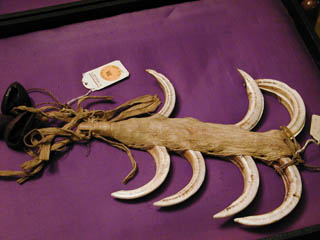
- Trophy Breast Pendant
Asmat people
Sepik River, New Guinea
19th century
Boar's Tusks, Bark Cloth
Bamboo, Seed Pods
26 x 20 x 2.5 cm.
Large trophy pendant of boar's tusks bound to a bamboo stick with bark cloth. Seed pod rattles hanging from bottom.
Good. Lacking one tusk. Old label and a Sotheby's label, Sotheby's Auction 1993.
|
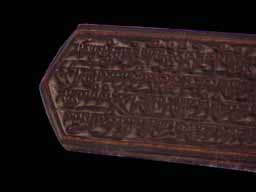
- Prayer Board/Printing Block
Tibet
19th century or earlier
Wood, Twine
Wood slab beautifully carved with Tibetan script. It was probably used as a printing block.
Fine condition with great patina.
|
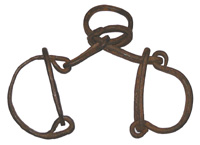
- Leg Shackles
Found in Senegal
Iron
12.5 inches long
Classis D-shaped leg shackles used in the west African slave trade. Probably for a child, as these are much smaller than others we have seen. Very good condition with residual rust.
|
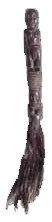
- 'Buffalo Tail'
mfunga mfumu
Discussion Chief's whisk
Yombe people, Democratic Republic of the Congo (Kinshasa)
Wood
Hair, Nail
37.5 x 3 x 3 cm.
Handle carved in the form of a man standing on a carved platform under which is the bust of a woman. The hair whisk projects from the woman's torso. The male figure wears a loin cloth and has his arms straight down at his sides.
CORNET, Joseph. A Survey of Zairian art. The Bronson collection. Raleigh, N.C.; 1978.
Very good condition. Small section of wood missing where nail penetrates handle to secure hair. Handle highly patinated from use.
|
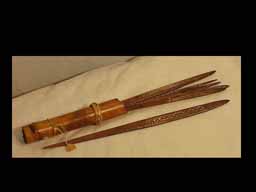
- Divination Rods
Asmat?
Sepik River, New Guinea?
Divining tools
Rods vary in size with the maximum circa 12 inches long
Fine condition with cracks in the bamboo case.
|

- Garment
Gikuyu? people
Kenya
circa early 1960's
Cotton
Poncho-like garment given to owner by Tom Mboya.
Fine condition. Slight rust discoloration.
|
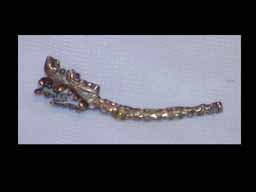
- Goldweight
'War Club' or 'Jaw Bone' Oliphant
Ashanti people, Ghana
Brass
cm.
The art of west African kingdoms. Smithsonian Institution Press, 1987. p.24
Fine condition.
|
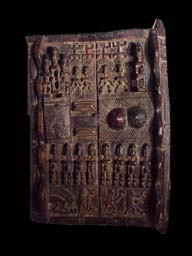
- Grainery Shutter
Dogon people
Bouganie, Mali
Wood
Metal Wrought Nails
65.5 x 47 x 5.3 cm.
This elaborate, carved door with sliding lock is rife with the symbolic icons of the Dogon. It, would have been used on a farmer's stone and mud silo for storing his harvest. The edges contain carved animals that have significance for the Dogon and the bottom edge depicts farmers going about their work. There are dancers wearing Kanaga masks and the locking mechanism shows the three original ancestors. The door is carved in very high relief. The lock is, likewise carved from one piece of wood. Many people feel the Dogon are privy to a special, supernatural knowledge because of their belief that they come from a spot in the universe (they'll point it out in the night sky!) that appears dark and blank to the naked eye, but is now known, with telescopic aid, to contain a galaxy.
Fine condition. Wired to hang on wall.
|
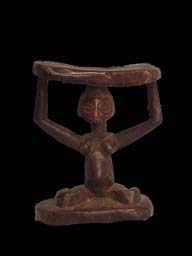
- Headrest
Luba people, Democratic Republic of the Congo (Kinshasa)
Wood
6 1/8 inches
Headrest, the curved upper part being supported by a squatting female with her hands over her head.
Very good condition.
|
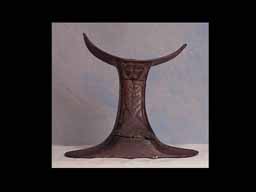
- Headrest
Ancient Egyptian
Democratic Republic of the Congo (Kinshasa) / Egypt
Before 1900 / Ancient World
Wood
20.6 x 22.6 x 7.9 cm.
I have not decided whether this an an ancient Egyptian or a 19th century Pende headrest? Constructed in two pieces: a U-shaped headrest mortice-and-tenoned to a square column that splays out into an elongated oval base. Incised designs on right and left sides with bas relief decorations on the front and back. Two of these latter reliefs, where the curved head-support meets the columned base, are carved faces with
projecting ears in the style of the important 'panya ngombe' masks. Nice, old brown patina.
HERREMAN, Frank & PETRIDIS, Constantijn, editors. Face of the spirits. Masks from the Zaire basin. Antwerp; 1993.
Old repaired cracks with recracking and shrinkage from aging. Tenon exposed from mortice shrinkage. Two old nails in base with remnant of paper (label?). #80 on paper, star-shaped label with faded script.
|
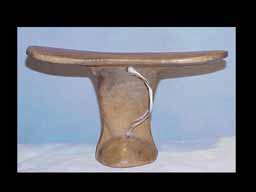
- Headrest
Kenya
Contemporary
Wood
Leather Thong
Fine condition.
|

- Beaded Hat
Kuba People, Democratic Republic of the Congo (Kinshasa)
Rattan
Buttons, Glass Beads
Wood tower insert as stand
Bakuba hat of basket-woven rattan adorned with milk glass buttons and pendant glass-bead strands.
Poor condition with sections of beads unraveling.
|
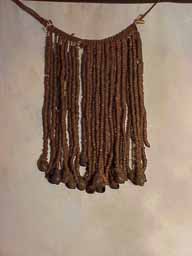
- Woman's Cache-Sexe
Kirdi
Northern Cameroon
Snake Eggs Drilled for Beads, Beetle Shells, Twine
A splendid and rare example of an object of female personal wear with substantial age.
Very good condition, lacking a few beetle shell end pendants. Close-up image
|
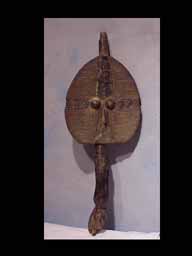
- Reliquary Figure
Bwete (Bwiti) Cult Figure
MaHongwe people
(probably Bushamaye subgroup)
Northeast Gabon
Metal over Wood
23 x 8.5 inches
MaHongwe reliquary figurines were set or attached in an upright position in baskets that contained the material remains of the owner's illustrious forebears, the cult of which was named bwete. Regardless of subgroup there are stylistic similarities in these figures. The 'faces' are spade-shaped and concave with a vertical metal band down the center. This band is broken by the projecting eyes and sharp nose. Descending from the eyes are lines of wire variously described as tears or moustache-like. In our example a band extends away from the eyes, continuing around the backside. The rest of the face is composed of carefully applied round wire strips which cover the face in uniform horizontal rows. The wire also covers about two inches of what would be described as the neck which continues below as a vertical shaft with a hollowed out split for a hand-hold. The face is topped by a wire-covered projection or chignon. The convex backside continues the wire strips and has two vertical center ridges covered with bands. For more images click here.
In describing a very similar figure in a collection in Geneva, Laure Meyer has written, "A non-realistic image of rare perfection of form, this figure remains disturbing even for the western observer. It should certainly be classed among the world's great art treasures." (Meyer p. 131)
This figure is a Domenico Terrana and L. Perrois Category I, Style 1 (Domenico Terrana & Louis Perrois. Die Stile der Kota-Reliquienfiguren.)
PERROIS, Louis. Les Bwete des Kota-Mahongwe. Libreville: 1969.
PERROIS, Louis. Art ancestral du Gabon dans les collections du musee Barbier-Mueller. Geneva: 1985.
MEYER, Laure. Black Africa. Masks, sculpture, jewelry. Paris: 1992.
Very good condition with verdegris encrustation of the metal and splendid patina on the divided support. Much deterioration of the support's base. A very nice and rare example.
|

- Ladder
Dogon people
Mali
circa 1930's
Wood
ca. 5 feet 7 inches tall
A beautiful example of the now well-known Dogon ladders. Unlike many we come across, this one is compact enough to show well in the smallish rooms of a modern apartment as well as the larger rooms necessary for its bigger brothers.
Extremely weathered but with a fine patina.
|
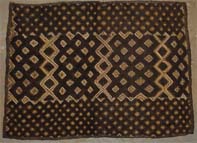
- Raffia Weaving
Kuba?
Democratic Republic of the Congo (Kinshasa)
Raffia
cm. / 21 x 29 inches
Mostly black weaving in a striking design. We were unable to comunicate with the Congolese trader from whom we purchased these, except to understand that he called the people who made these items (or called the items themselves) Boutara.
Fine condition.
|
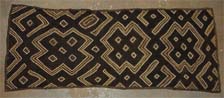
- Raffia Weaving
Kuba?
Democratic Republic of the Congo (Kinshasa)
Raffia
cm. / 19 x 45½ inches
Mostly black weaving in a striking design. We were unable to comunicate with the Congolese trader from whom we purchased these, except to understand that he called the people who made these items (or called the items themselves) Boutara.
Fine condition.
|
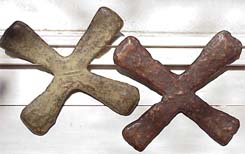
- Ingot (Katanga Crosses)
Luba people
Republic of the Congo
circa 1880's - 1900
Puddle Cast Copper Alloy
ca. 8 x 8 inches
We have an excellent assortment of good examples of the so-called Katanga crosses used as media of exchange in the Congo basin circa 1700-1900.
Only one remaining in stock (left ingot in photo.) Fine condition. Click here to see reverse side of crosses.
|

- Handle or Sceptre
Mende people
Sierra Leone
Wood
cm. / inches
Sceptre or handle with an archetypal Bundu head at one end
Very good condition.
|

- Staff
Lobi
Wood
cm. / inches
|

- Staff
Tuareg
probably Niger
Wood, Leather
cm. / inches
Fine condition with native leather repair.
|

- Staff / Sceptre/ Baton
Dogon
Mali
cm. / inches
A round staff ending with an extended square section with a trough on one of its four sides that is carved with geometric designs.
Fine condition.
|

- Kirdi Skirt
Kirdi people
Cameroon
Beads, Twine
cm. / inches
|

- Beaded Hat
Cameroon
Cowrie Shells, Cotton Cloth, Mirrors
cm. / inches
|
Weapons
|
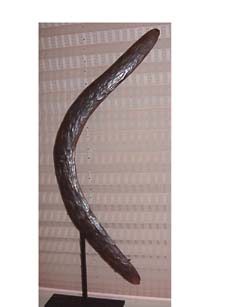
- Boomerang
Aboriginal peoples
Australia
Collected before 1905
(mid-19th Century or earlier)
Stone adze carved wood
x x cm. / 22 inches shortest distance tip to tip
A magnificent stone-chipped boomerang in splendid condition. See the reverse.
Ex-Collection Hornshaw, Australia.
Fine condition with custom-made display stand.
|

- Spear
Senufo
Iron
cm. / inches
|
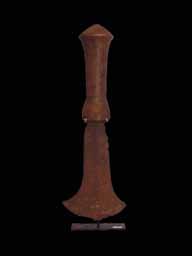
- Knife
Baule people
Côte d'Ivoire
1930s
Wood, iron, remains of gilt, metal nails
Wire armature stand painted black
Fine condition.
|
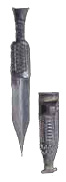
- Dagger with Sheath
Shona people
Zimbabwe
Wood, Metal
26.7 x 3.8 x 3.3 cm.
A type of dagger found among several peoples in southern Africa. The handle is carved from one block of wood into which the blade is afixed. The sheath is two pieces of carved wood, front and back, held together with wire twistings. One side has a carved extension holed for attachment to a belt or garment.
Very good condition. Paint on rear of sheath has been stripped.
|
|